
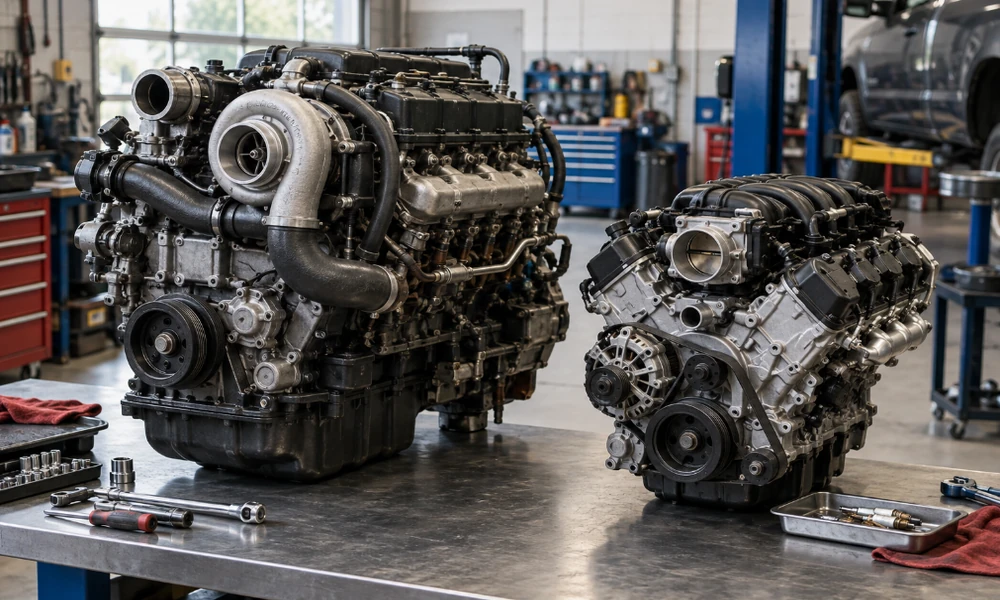

Diesel and gasoline engines both turn fuel into power, but they do it in different ways. Those differences affect how the engines perform, how they wear down, and how technicians repair them.
At first glance, many engine parts may look similar. Both types have pistons, cylinders, valves, cooling systems, and motor oil. Still, diesel repair often involves heavier components, higher pressures, and different diagnostic steps.
Different Ways of Igniting Fuel
A gasoline engine uses spark plugs to ignite a mixture of gasoline and air. When a spark plug wears out or an ignition coil fails, the engine may misfire, shake, or struggle to start.
Diesel engines do not use spark plugs for combustion. Instead, they compress air until it becomes extremely hot. Diesel fuel is then injected into that hot air, causing combustion.
Some diesel engines use glow plugs to help with cold starts. However, glow plugs do not continuously ignite the fuel like spark plugs do. This changes how a technician investigates starting problems.
Diesel Fuel Systems Operate Under High Pressure
Fuel delivery is one of the biggest differences between diesel repair and gas engine repair. Modern diesel engines use high-pressure fuel pumps and precise injectors. These systems may operate under extremely high pressure, so special tools and careful safety procedures are needed.
A small amount of dirt or water can damage a diesel fuel system. A clogged fuel filter, worn injector, or failing high-pressure pump may cause poor acceleration, rough running, excessive smoke, or hard starting.
Gasoline engines also have fuel pumps and injectors, of course. Their systems are important, but they generally operate at lower pressures than modern common-rail diesel systems.
Diesel Parts Are Built for Greater Stress
Diesel combustion creates high pressure inside the cylinders. To manage that force, diesel engines often have stronger blocks, pistons, crankshafts, bearings, and connecting rods.
These heavy parts can help a diesel engine last a long time when it receives proper care. The tradeoff is that repairs may require more labor. Components can be larger, harder to reach, and more expensive to replace.
Technicians working on diesel engines may also need equipment made for heavier vehicles. Even removing a part can become a bigger job than expected. It depends on the vehicle, but space is often tight.
Turbochargers Are More Common
Many diesel engines use a turbocharger to push additional air into the engine. This helps produce strong torque without using an extremely large engine.
A turbocharger operates at high speed and depends on clean oil for lubrication. Dirty oil, restricted airflow, boost leaks, or damaged oil lines can cause trouble. Common warning signs include reduced power, unusual whining sounds, oil consumption, and smoke from the exhaust.
Gas engines can also be turbocharged, but turbochargers have been common in diesel vehicles for a long time. As a result, checking the turbo and related hoses is often a routine part of diesel repair.
Emissions Systems Require Different Knowledge
Modern diesel vehicles have specialized emissions equipment. This may include a diesel particulate filter, exhaust gas recirculation system, diesel oxidation catalyst, and selective catalytic reduction system.
A diesel particulate filter captures soot from the exhaust. The engine periodically raises exhaust temperature to burn much of that soot away through regeneration. If regeneration keeps failing, simply replacing the filter may not solve the actual problem. A bad sensor, injector issue, air leak, or driving pattern might be involved.
Gas vehicles use emissions equipment too, including oxygen sensors and catalytic converters. However, their systems work differently and produce different diagnostic codes and symptoms.
Maintenance Needs Are Not Identical
Both engines need regular oil changes, clean filters, proper coolant, and quick attention when warning lights appear. Diesel engines may hold more oil and require oil designed for diesel operation. Fuel-filter service is also especially important because diesel injection components are sensitive to contamination.
Gas engines usually have ignition parts such as spark plugs that require periodic replacement. Diesel engines have their own concerns, including glow plugs, water separators, turbochargers, and emissions-system maintenance.
Specialized Diagnosis Matters
Diesel repair is not necessarily better or worse than gas engine repair. It is simply different. Diesel engines involve high compression, high-pressure fuel delivery, heavy internal parts, and specialized emissions systems.
Proper diagnosis matters for either engine. Replacing parts based only on a symptom can become expensive very quickly. Understanding how the engine creates power allows a technician to locate the actual cause and complete a repair that lasts.
This post was written by a professional at Kepkee’s Diesel & Performance. Kepkee’s Diesel & Performance is a full-service diesel repair company in Largo, Florida, specializing in automotive engine repairs, diagnostics, maintenance, transmission work, and performance upgrades. For drivers searching for Diesel Engine Repair Service in Seminole, FL, our team provides dependable support throughout Pinellas County. As one of the leading diesel repair companies near you, we offer expert guidance and reliable solutions, making us a trusted choice for diesel repair near you focused on quality, value, and performance.